TAggImageFilter
Description
TAggImageFilter defines the type of pixel-image aliasing resample operation when enlarging or shrinking bitmaps.
This resample operation (filter or in most cases interpolation) of images occurs when user resizes or remaps (distorts) image from one pixel grid to another. Image resizing is necessary when user needs to increase or decrease the total number of pixels, whereas remapping can occur under a wider variety of scenarios: correcting for lens distortion, changing perspective, rotating an image, etc.
Interpolation works by using known data to estimate values at unknown points.
Image interpolation works in two directions, and different alghorithms tries in a variety of ways to achieve the best approximation of a pixel's color and intensity based on the values at surrounding pixels.
Constant Values
AGG_NoFilter
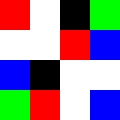
No smoothing, just nearest neighbour method (point sampling) is used. The closest pixel center to each sample grid point is used, with no input from other surrounding pixels.
AGG_Bilinear
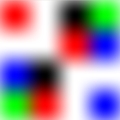
A sample point takes the four closest pixel centers and linearly interpolates their color values according to their distance from the sample point. The averaging has an anti-aliasing effect and therefore produces relatively smooth edges with hardly any jaggies.
This method is particularly useful when an image is being enlarged, or transformed or distorted without decrease in average size.

AGG_Hanning
Results in medium quality image with medium performance.

AGG_Hermite
The Hermite method interpolates using Hermite spline interpolation.
Results in medium quality image with medium performance.
AGG_Quadric
Results in good image quality with slightly higher performance.

AGG_Bicubic
Is more sophisticated and produces smoother edges thanbilinear interpolation.
Bicubic goes one step beyond bilinear by considering the closest 4x4 neighborhood of known pixels - for a total of 16 pixels. Since these are at various distances from the unknown pixel, closer pixels are given a higher weighting in the calculation. Bicubic produces noticeably sharper images than the previous method bilinear, and is perhaps the ideal combination of processing time and output quality.

AGG_Catrom
Catmull-Rom splines are frequently used to get smooth interpolated motion between key frames. They are popular mainly for being relatively easy to compute, guaranteeing that each key frame position will be hit exactly, and also guaranteeing that the tangents of the generated curve are continuous over multiple segments.

AGG_Spline16, AGG_Spline36
An approximation of spline interpolation, for some applications its result may be too smooth and blurry, but when using with large magnification factors, it usually yields better image compared to bilinear.

AGG_Blackman144
Results in slightly distorted image quality with high performance.